BREAKING NEWS
Tampilkan postingan dengan label EUR. Tampilkan semua postingan

Minggu, 30 Agustus 2015

All eyes on the ECB

The ECB is expected to nod in the direction of further policy easing at this week's Governing Council meeting (Thursday), with risks skewed toward more forward-leaning guidance and possibly even action. Since the last policy meeting in July, effective appreciation of the EUR, falling commodity prices, and an elevation of the risks to foreign growth have reduced the near- and medium-term inflation outlook and tighten overall financial conditions as breakevens have fallen anew. The ECB staff macroeconomic projections are likely to show a downward revision in inflation forecasts for both 2015 and 2016. Thus, the ECB, at a minimum, is expected to signal its ability and willingness to ease further if monetary and financial conditions tighten further. 

By year-end, it is expected that the ECB will announce an extension of the minimum period for its asset purchase program - an announcement that may even come next week - and possibly in the future extend the size and scope of the purchase program or a cut in the deposit rate further into negative territory. 

"We believe that the last of these measures - although highly unlikely at next week's meeting - would be most effective in generating greater downward pressure on the EUR, but all should lead to some measure of additional depreciation", says Barclays.

In terms of data, consensus expect August euro area "flash" HICP inflation to have declined by 0.1 percentage point, to +0.1% y/y in August (Monday), and core inflation to have eased to +0.9% y/y, from +1.0% y/y previously. Headline inflation is expected to decline further to zero in September and October before it starts recovering from November onward. Final August euro area manufacturing and services PMIs (Tuesday and Thursday, respectively) are likely to be confirmed at 52.4 and 54.3, in line with the consensus forecasts.

Senin, 30 Maret 2015

Greece running out of time to produce a comprehensive list of reforms

Late last week, Greece submitted the third iteration of the list of proposed reforms demanded by eurozone finance ministers as a pre-condition for the payment of the outstanding tranche of €7.2bn from Greece's second bail-out.

However, the list has been dismissed as "a set of ideas" by some euro-zone officials, who are reportedly awaiting a more comprehensive and detailed version in the next few days.

Greece is running out of time to produce a list of reforms that will satisfy its creditors and secure the additional bail-out payment it requires to meet its near-term financial obligations. But even if it is successful, the much more daunting challenge of finding a lasting solution to the country's unsustainable debt burden will still lie ahead.

"Even if Greece manages to secure its remaining bailout payment, this will provide nothing more than a stop-gap, and a short one at that. The much bigger challenge of finding a lasting solution to Greece's debt problems will still lie ahead.

We continue to believe that only a major debt write-down can ultimately provide that solution, a prospect Greek Prime Minister Alexis Tsipras has recently begun to talk about again. But it remains doubtful that this will be achievable as long as Greece remains inside the euro.

In short, we maintain the view that the markets are under-estimating the likelihood that Greece leaves the euro at some point, and the potential financial and economic effects of such an event." - said Capital Economics in a report on Monday. 

European confidence review

European Central Bank's (ECB) asset purchase program has pushed confidence across and beyond the region. Consumer, industrial, services all painted bullish mood across the zone.
  • Consumer confidence rose to -3.7 from previous -6.7. In December 2014, it was close to 12.

  • Business climate indicator rose to 0.23 from previous 0.07. It has been falling since November 2014 until latest release today.

  • Economic sentiment across EMU rose to 103.9. This is a consecutive rise of four months.

  • Industrial confidence rose to -2.9 from prior -4.7. This is a second consecutive rise.

  • Services confidence rose to 6 from prior 5.3. The index posted fourth consecutive rise.
Impact -
Indicators across EMU suggests that ECB's monetary policy easing through asset purchase is sipping in through real economy and boosting confidence pan industry.

However Euro's reaction is somewhat mute over the release, currently trading at 1.086. Most of the benefits of improved condition and weaker Euro will be enjoyed by the stock market. European stocks remain relatively cheaper and has a lot of scope to move up.

11th hour negotiations continue in Greece

Negotiations continued over the weekend between Greek officials and Euro zone inspectors known as Brussels Group that comprises of ECB, IMF, European council and ESM. Talks lasted several hours and on Saturday for consecutive 10 hours at one stretch.
Latest information suggest positive improvement over some aspects, however a lot remain yet to be covered.

Key highlights -
  • Greece has so far given up on two of demands of creditors - increasing VAT on Greek Islands and to retain property taxes that has been very unpopular among public. These measures are expected to increase revenue by € 2.5-3 billion.
  • However, significant gap still remains over labor laws and pension reforms.
  • Brussels group officials still thinks the latest list provided by Greek government is still too vague and lack further specification on how the measures would be achieved.
Greek Prime Minister Alexis Tsiparas has called the lawmakers on a special meeting at 8pm Athens time today, where he will be briefing about latest weekend negotiation and stance of his government.
  • Greek is not very far from running out of money, probably by 8th April and before the payment of € 0.45 billion to IMF on 9th. Greece can avail the remaining € 7.2 billion from current bailout fund upon successful agreement over reforms. Government has taken today as a deadline to finalize the deal, however negotiation might get extended.

Euro is currently trading 1.085 and might receive a boost from successful deal which seems to be underway but might take some more time.

Senin, 23 Februari 2015

Hindari Default, Yunani Perpanjang Bailout

Alexis SyrizaPemerintahan baru Yunani akhirnya mendapat perpanjangan program bailout dari para kreditor, untuk menghindari default dan keluarnya negara itu dari zona euro.

Tapi Yunani hanya mendapat perpanjangan empat bulan, bukannya enam bulan seperti yang diminta. Tidak sampai di sana, Athena juga harus menyerahkan proposal yang mencakup daftar reformasi. Pemerintah harus menyediakan rencana detil program dan anggaran.  Ada spekulasi yang menyebutkan daftar itu mencakup pengurangan tenaga PNS dan memerangi penghindaran pajak.

ECB, Uni Eropa dan IMF, atau yang disebut dengan troika, akan memutuskan apakah proposal itu cukup untuk mengeluarkan bantuan finansial sekitar 7,2 miliar euro. Namun, kalaupun disetujui, kelanjutan bailout kemungkinan baru dikucurkan setelah April, menambah masalah keuangan pemerintahan dan mempersulitnya memenuhi janjinya menaikkan upah minimum.
Perdana Menteri Yunani Alexis Tsipras mengklaim berhasil mencapai kesepakatan dengan sekaligus membatalkan penghematan yang dijalankan pemerintahan sebelumnya. Ia mengatakan kesepakatan dengan Eurogroup membatalkan komitmen penghematan seperti pemotongan upah dan pensiun, mengurangi PNS dan menaikkan pajak pada makanan dan obat-obatan.

Namun banyak juga yang kecewa dengan hasil negosiasi ini. Dengan memperpanjang bailout dan harus menyerahkan porposal, Yunani sama saja menyerah dengan tuntutan kreditor. Selain itu, perpanjangan bailout belum tentu mengamankan masa depan Yunani dalam blok mata uang itu. Athena diperkirakan akan membutuhkan program bailout ketiga Juni nanti ketika harus menembus obligasi sebesar 6,7 miliar euro ke ECB pada Juli dan Agustus.

Sumber : Strategydesk

Minggu, 22 Februari 2015

Greece secures bailout extension, more negotiation ahead

Greek government and the Euro zone creditors have secured a deal of bailout extension of 4 months in late Friday. Important takeaways-
  • Greek government will get the rest € 7.2 billion aid package, the final tranche of current bailout programme if the deal is successful.
  • To secure the bailout extension the Greek government will be required to come up with a series of reform and budget cuts to TROIKA (ECB, IMF, European Commission) today, 23rd February.
  • Tomorrow, 24th February European finance ministers will reconvene to finalize the deal.
  • A success deal would keep the Greek government, especially the banks afloat in the midst of a heavy deposit withdrawal of approximately € 2 billion/week.
  • Despite the scheduled time frame, a negotiation could extend beyond Tuesday as the bailout officially does not expire till February 28th.
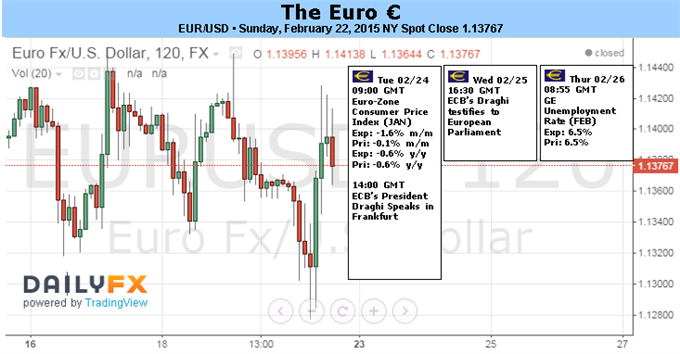
The Euro has taken the news with pinch of salt, currently trading around 1.135 against the Dollar. The pair is still treading water within its tight range of 1.127-1.145. Depending on the outcome the pair could move into its larger range of 1.11-1.165.

Greece Kicks the Can again, Euro Only Benefits if Focus Turns to Data

Greece Kicks the Can again, Euro Only Benefits if Focus Turns to Data
Fundamental Forecast for Euro: Neutral
- The retail crowd remains net-short EURUSD, but has taken the dips as an opportunity to reduce shorts.
- Technical breakdowns in EURJPY and EURUSD have been disrupted by Greek-related headlines.
- Have a bullish (or bearish) bias on the Euro, but don’t know which pair to use? Use a Euro currency basket.
 
After a week filled with doubt and uncertainty, the Euro was able to look past tumultuous headlines surrounding the Greek-Eurogroup debt negotiations, and finish mostly unchanged against a basket of its major counterparts. On the extremes, EURAUD fell by -1.15% and EURCAD gained +0.55%, while in between EURGBP slipped by -0.14% and EURUSD edged lower by -0.11%. Needless to say, these price movements aren’t exactly the signs of the wheels falling off the Greek negotiations, or an existential crisis about the fate of the Euro entering the discussion. 
 
Traders, having already embraced one of the most bearish views of the Euro on record – having entered the week with 194.6K net-short contracts on the books, just shy of the all-time high of 214.4K net-shorts set during the week ended June 5, 2012 – may have simply reached an exhaustion point for interpreting Greek-related headlines. With short positions having been marginally reduced for the week ended February 17 (down to 185.6K net-short contracts), traders may be best suited to take advice from one of the legends, George Soros: “The worse a situation becomes the less it takes to turn it around, the bigger the upside.”
 
Lingering concerns over how the Greek agreement with the Eurogroup plays out are holding the Euro back. The extension agreement kicks the can down the road for four months, eliminating an immediate insolvency concern, but does little to address the ongoing liquidity crisis faced by Greek banks. Estimates suggest that some €100bn have been withdrawn from Greek banks over the past three-months, leaving the Greek banking system wholly-reliant on the European Central Bank’s emergency lending assistance (ELA) facility. For now, with the possibility that the ECB restricts ELA access (like it did to Cypriot banks in 2013), traders may be keeping their bearish Euro positions on the table with an eye towards capital controls and bank holidays hitting Greece over the coming weeks.
 
If only markets were able to shift their attention away from Greece, might the Euro be able to benefit. As we saw in the first set of ECB minutes released on Friday, the debate within was not only about the timing of a QE program (non-news; we know it begins in March) but also about what conditions could necessitate the end of the German-despised, expansionary program. This is a conversation worth paying attention to, especially now that incoming data from the Euro-Zone is improving at a solid pace.
 
The Citi Economic Surprise Index for the Euro-Zone hit +56.1 at the end of the past week, its highest level since March 7, 2013 (+56.5), while blowing out to its widest spread against its US equivalent since September 2010. In other words, relative to expectations, Euro-Zone data has been outpacing US data at its best clip in nearly four and a half years. Accompanying the improved data have been measures of rate expectations backing off all-time extremes, too. Morgan Stanley’s ‘months to first rate hike’ index (MSM1KEEU) resides at 45.6 (suggesting a December 2018 rate hike), down from levels seen over the past few weeks suggesting that rates would remain unchanged until March 2019.
 
The Euro-Zone is still a bonafide mess, politically and economically, but the data has undoubtedly been more positive in recent weeks. Inflation expecations have steadied too: the 5-year, 5-year inflation swaps (FWISEU55) ended the week at 1.603%, just above the four-week/20-day average of 1.586%. But for lingering concerns over Greece, the current 185.6K net-short contracts among speculators looks overdone – providing a viable source of tinder for a short covering rally. –CV

Source : dailyFx 

Jumat, 20 Februari 2015

Europe grows – PMI shows evidence

Despite the bearish outlook maintained over Euro, it was reiterated that better data is coming out of Europe. PMI data for European Monetary Union was released today at 9 GMT.
Key figures -
  • Latest PMI figure is 51.1 compared to 51 prior for the Euro zone, though market expectation was of a better reading.
  • It is worth noting that the overall EMU PMI did better, when the reading from Germany faltered at 50.9 against an expectation of 51.5.
  • France, Euro zone's second largest economy is not performing well and also behind the economic reform compared to many of its partner. Growth in France dropped faster than anticipated as evident from the latest PMI figure which stands at 47.7, even worse than prior 49.3.
  • During the same time industrial data was also released that showed that Italy another large but troubled economy experienced growth, 5.8% YoY and 4.5% mom.
 Improving data and growth divergence will be of greater importance in the coming days as stock and bond performance might diverge in the Euro zone.
For now the effect of the data on Euro should be minimal as other pressing concern like Greece & ECB bond purchase remains the focus.
 
Back To Top
Distributed By Blogger Templates | Designed By OddThemes